
Join us on the Community Forums!
-
Community Guidelines
The Fitbit Community is a gathering place for real people who wish to exchange ideas, solutions, tips, techniques, and insight about the Fitbit products and services they love. By joining our Community, you agree to uphold these guidelines, so please take a moment to look them over. -
Learn the Basics
Check out our Frequently Asked Questions page for information on Community features, and tips to make the most of your time here. -
Join the Community!
Join an existing conversation, or start a new thread to ask your question. Creating your account is completely free, and takes about a minute.
Not finding your answer on the Community Forums?
- Community
- Health & Wellness
- Sleep Well
- Re: Is this normal? Deep sleep to awake
- Mark Topic as New
- Mark Topic as Read
- Float this Topic for Current User
- Bookmark
- Subscribe
- Mute
- Printer Friendly Page
- Community
- Health & Wellness
- Sleep Well
- Re: Is this normal? Deep sleep to awake
Is this normal? Deep sleep to awake
- Mark Topic as New
- Mark Topic as Read
- Float this Topic for Current User
- Bookmark
- Subscribe
- Mute
- Printer Friendly Page


 Fitbit Product Experts Alumni are retired members of the Fitbit Product Expert Program. Learn more
Hi @dan801,
It's difficult to say. What's normal for one person is abnormal for another. I don't think it's one size fits all.
The important thing is: How do you feel upon waking? Rested? Do you fall asleep easily, or does it take some time?
Deep sleep is tied to the body's process of repair. If the amount of deep sleep is inadequate, you will feel those effects before long.
 Best Answer
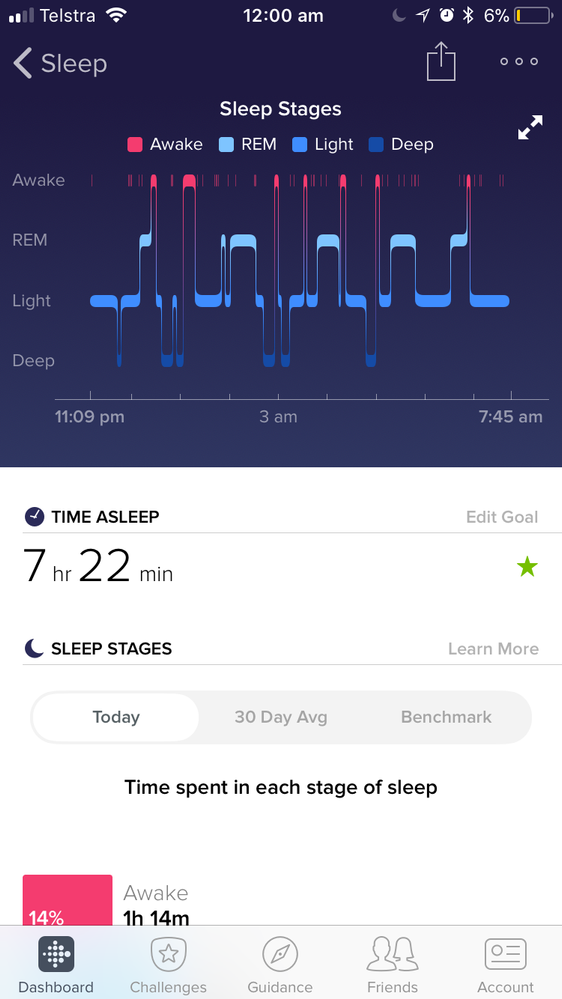
My 30 day average is less than 30minutes deep sleep (6 per cent) which is way below average. Just don’t understand why I go from a very short deep sleep to instantly awake. The graph is pretty accurate in terms of when I wake at night and how I feel the next day. I fall sleep instantly but very poor sleep. I get 8 hours sleep
Best Answer
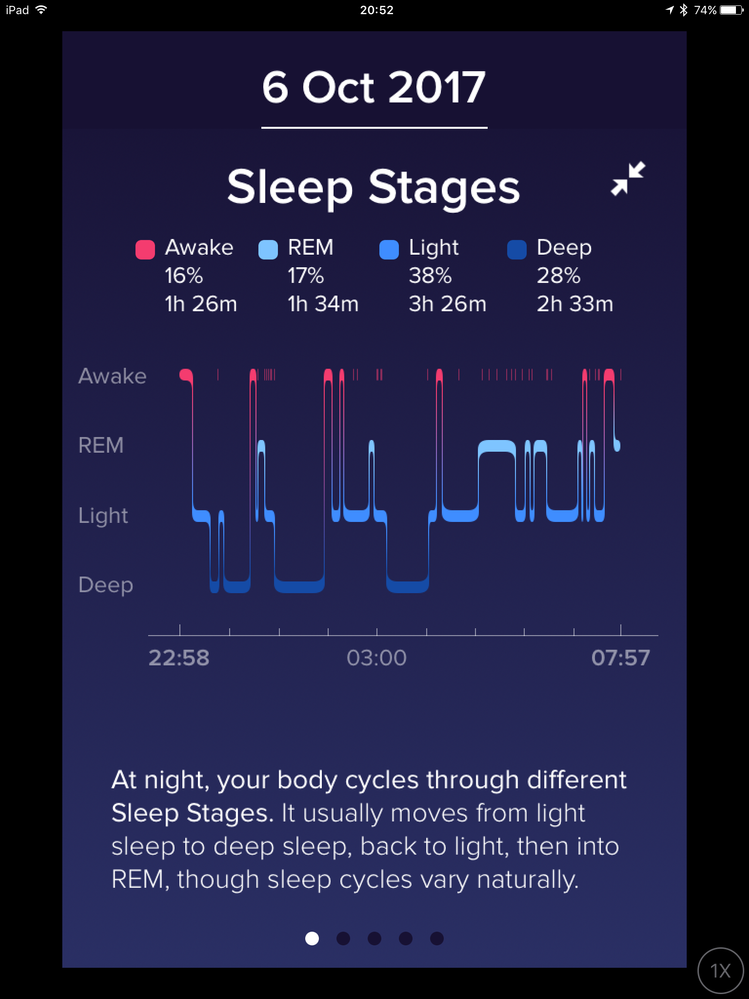
Your chart has similarities to mine. Straight from deep sleep to awake. I'm wondering if this is a sign of apnea. My wife says I do snore terribly loudly. I might need to get a sleep study done.

I can't upload a picture at the moment but, to me, your pattern shows clear signs of sleep apnea. I only know this because it resembles mine and I've had sleep apnea for nearly a decade now.
 Fitbit Product Experts Alumni are retired members of the Fitbit Product Expert Program. Learn more
Thanks @PieChi, @dan801, @BrianUK for posting here. The new Ionic is going to have o2 monitoring that should help identify sleep apnea. But it's great to see that the sleep stages charts are giving good information for this also.
If you do have sleep apnea, please post a screenshot of one of your sleep charts here, so we can all benefit from the comparisons.
Best Answer
Sorry I tried adding a picture but when I click the camera it doesn't give me the option to. Not sure why this is the case.
Best Answer
@WavyDavey Hi - I posted a screen shot of my data above. I've just bought my Fitbit 2 so I won't be buying the ionic until this one stops working. But if the Ionic does monitor O2 then that is a huge leap forward for wearables!
It's really helpful to see the sleep charts of others for comparison. The more the better.
Best Answer
Fitbit Product Experts Alumni are retired members of the Fitbit Product Expert Program. Learn more
@BrianUK wrote:@WavyDavey Hi - I posted a screen shot of my data above. I've just bought my Fitbit 2 so I won't be buying the ionic until this one stops working.
Thanks, I think that's a great contribution to the community. I checked my sleep charts, which are sometimes disturbed. But it always goes from deep to light to awake, never deep to awake like the charts above.
I'm tagging @zapleahy, as I think Fitbit might find this information interesting.
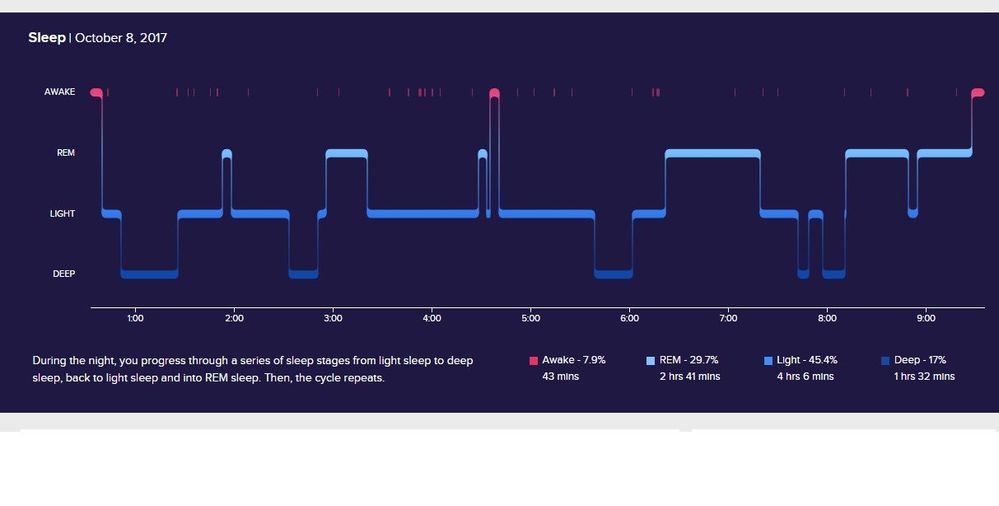
@PieChi Thanks for,posting this. Is this taken with CPAP? Mine looks to be a lot worse than yours if we are looking at deep,sleep direct to awake spikes. What is it about your graph that indicated apnea in your opinion?
I was diagnosed with sleep apnea almost 10 years ago (I believe it was around 26 AHI). I had my last sleep study about 2 years ago, still had it (though to a lesser extent-14 AHI). I believe I have minor sleep apnea at the moment.
I was prescribed a CPAP machine but I found it impossible to sleep with. Instead I'm hoping that I can lose enough weight and that will have an effect on it.
In my non-medical opinion you can tell an apneic episode by the short (about 1 minute) arousals shown in the above graph. They're hard to tell but they are there if you look closely. As you can see in my sleep pattern every deep sleep stage it is interrupted by a light pink "awake" stage which then proceeds to a light sleep stage.
Fitbit Product Experts Alumni are retired members of the Fitbit Product Expert Program. Learn more
Take a look at this Fitbit article that indicates that the average person can have many awakenings per night. The duration is so short, that we don't remember them. I'm not sure the placement of those tiny awakenings indicates a medical issue.
But this is all new stuff. Thanks everybody for posting your charts.

Thanks guys for posting these pictures. My sleep graph often looks similar to what BrianUK posted, and I had wondered whether it was actually normal.
@WavyDavey as I mentioned in this thread, Fitbit sleeps to detect awakenings of 30 seconds or greater, but I believe the source for that article in which Fitbit mentioned awakenings actually deals with awakenings of an even shorter duration.
Really if you're having multiple (dozens as seen in my graph) micro -awakenings it most likely is some kind of issue that should be checked medically.
@WavyDavey or @zapleahy Do you know if there is a resource bank of images of people who know they do not have apnea or other disorders. I.e. A normal set of results. This would be most useful for comparison. Could you post one of your sleep images if you are a "normal" sleeper.

I have a lot of those little red lines as well, but I do not think I have sleep apnea. I'm often tired but I think just think I don't sleep enough--go to bed too late & up too early. I also get very little deep sleep according to Fitbit. 7% on average, with many night registering less than 20 minutes of deep sleep. But my average for "awake" is less than average as well, just 10% compared with a population average of 12-24% awake.

